Kaizen · 2024–2026

Kaizen

Since 2024 Buckner DC has entered Ryder's CPG Kaizen competition each year with a short film that takes one improvement through Plan, Do, Check and Act. These are the last three entries. Two of them won.

No. 2026

Beacon VTS

Next.js, TypeScript, Firebase.

Dozens of spreadsheets and a different tool at every site. Beacon replaced them with one web system for VAS production tracking, piloted at Buckner and carried to three more facilities.

Prize · Ryder CPG winner

Runtime 11:19

  • $432,625documented savings across four facilities
  • +59%case volume at a flat cost, 2024 to 2025
  • 30%less setup time at Buckner
  1. Plan: The problem

    • Dozens of scattered spreadsheets and no central system. Each site ran its own tools, handoffs ran late, and with team size, the full-time and temp mix and headcount always changing, every new person faced a steep learning curve.
    • Root cause: work tracked in archaic tools (Excel, Access, Word) where a standard web-based system was needed. The fishbone traced it to fragmented workflows, siloed knowledge, spreadsheet dependencies and no real view of productivity.
    • Target: one standard tracking tool that runs anywhere, modular and customizable, distributed to every VAS operation.
  2. Do: The countermeasure

    • Built Beacon VTS on Next.js, TypeScript and Firebase: build schedule, hour tracker, KPI dashboard, T.O.S.H. coverage analyzer, labor analyzer, production history and daily synopsis.
    • Checkpoint puts each build and its visual work instructions on the floor TV, so no one is hunting for a paper SOP or a supervisor.
    • Rolled out in four steps: Buckner, KY (pilot), Kansas City, MO (validate), Columbia, SC (scale) and Carlisle, PA (custom).
  3. Check: The results

    • Case volume went from 747,437 in 2024 to 1.2 million in 2025 with the cost structure flat.
    • Documented savings: Buckner $345,452, Kansas City $31,880, Columbia $40,895, Carlisle $14,398. Total $432,625.
    • At Buckner, cases per labor hour rose 133% from August to December 2025, peaking at 95.0 in December. Setup time fell 30%, and search time fell by more than 90%: hours became seconds.
  4. Act: Holding the gain

    • John Smith owns the process, with continuous-improvement oversight from Harish Kulkarni.
    • Multi-factor sign-in, role-based access and audit logging protect the data.
    • It runs for about $0.12 a month in cloud costs, where enterprise systems start at $100K.
Jim Stafford
Sponsor
Derrick Drake
Developer
John Smith
Developer
Bob Gomez
Engineer
Oscar Aranda
Engineer
Eric Sloan
Engineer
Mark Gondres
Tester
Harish Kulkarni
CI oversight

No. 2025

Door to Warehouse Tool

Excel macro, SAP exports, PowerApps.

Outbound pallets were travelling further than they had to, because the dock door chosen for a shipment wasn't always the one nearest its pallets. Now a coordinator tool picks the door.

Entered · Kaizen submission

Runtime 6:31

  • 34 ssaved on every pallet picked
  • $35,700saved, year to date when filed
  • July 2024in daily use at Buckner since
  1. Plan: The problem

    • Outbound picking had too much travel. Coordinators assign a dock door to each shipment, and the door chosen wasn't always the best one for where that shipment's pallets sat, so lift-truck operators drove long routes and outbound ran late.
    • Other Ryder CPG sites use dock-door tools for this, but those need direct WMS access the customer's setup doesn't allow, so they couldn't be used here.
    • Target: a simple tool coordinators can run on data they can already export, to cut lift-truck travel. Accounts already zoned by door were left out.
  2. Do: The countermeasure

    • John Smith built the tool in Excel. Every storage bin sits on an X/Y grid of the building, and the sheet holds each bin's straight-line distance to every door.
    • A coordinator exports the shipment's orders from SAP, enters the shipment number, and the tool returns the best door for the pallets to be picked.
    • Coordinators were trained on it, and it later moved to PowerApps with a SharePoint list of shipments and doors.
  3. Check: The results

    • A time study of 300 picks each way: 4:09 average without the tool, 3:35 with it. That is 34 seconds saved on every pallet.
    • $35,700 saved year to date when the entry was filed.
  4. Act: Holding the gain

    • Built into the coordinators' release routine: SAP outbound delivery, transfer orders, shipment number into the tool, door assigned.
    • In daily use at Buckner since July 2024.
Derrick Drake
Team lead
Jim Stafford
Sponsor
Nate Henise
Co-sponsor
John Smith
Developer
Eric Sloan
Engineer
Oscar Aranda
Engineer
Zach Willis
Coordinator
Roy Carroll
Coordinator
Ali Allami
Coordinator
Dan Del Rio
Buckner team

No. 2024

Digital OCT Boards

Six wall monitors, Yodeck players, Raspberry Pi.

The Operations Control Tower (OCT) moved off paper and whiteboards onto six live monitors, one per topic, then into a Ryder SOP and out across the vertical.

Prize · Ryder CPG winner

Runtime 9:57

  • $182,548saved across safety, productivity and retention
  • 68facilities in the U.S., Mexico and Canada
  • 15,000+employees see the boards every day
  1. Plan: The problem

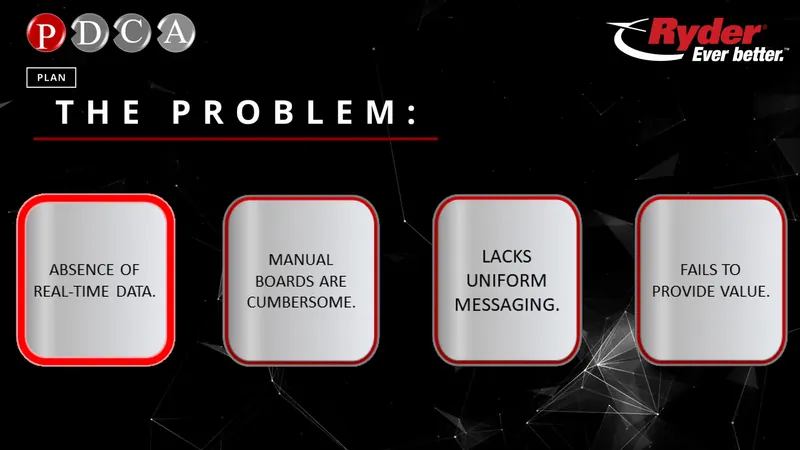
    • The Operations Control Tower boards were paper printouts and whiteboards: cumbersome to update, never real-time, with no common message across the vertical and little value to the people walking past.
    • Root cause, by fishbone: information (no real-time data), process (manual boards), system (no uniform messaging) and productivity (no value delivered).
    • Target: a KPI-centric digital control tower that is easy to read and maintain, shows real-time data to associates and visiting customers, and carries leadership's message.
  2. Do: The countermeasure

    • Redesigned the tower as six monitors following SPQDC: Safety, Quality, Cost, People, Delivery and Continuous Improvement.
    • Yodeck media players on Raspberry Pis run the screens and can be updated from anywhere. Owners refresh Safety, Quality, Delivery and Cost daily, and People and CI weekly.
    • Site boards add work standards, the voice of the customer and recognition for top lift-truck operators.
  3. Check: The results (Buckner, 2022 to 2023)

    • Cases per labor hour up 5%, from 362 to 381. Overtime spend down 16.4%.
    • Rolling 12-month turnover down from 101.85% to 88.46%. Recordable injury rate (ORIR) down from 2.12 to 1.67.
    • Savings: safety $31,000, productivity $95,748, retention $55,800. Total $182,548.
  4. Act: Holding the gain

    • Written into a Ryder SOP for maintaining a site's Operations Control Tower.
    • Rolled out to 68 facilities across the U.S., Mexico and Canada, with more planned.
Derrick Drake
Team lead
Jim Stafford
Sponsor
Eric Sloan
Team member
Dan Del Rio
Team member
John Smith
Team member
Tiffany Mcintosh
Team member